
Law Firm Profitability: How to Fix a Broken Profit Equation
By Chelsea Williams, Chief Financial Architect | Profit Kept
At-a-Glance: What You'll Learn
Why law firm profitability feels unpredictable even when revenue is strong
The most common signs of a broken profit equation
A three-step system for protecting profit before expenses take over
How to improve law firm profitability without chasing more revenue
What predictable profit actually looks like inside a well-run firm
When a law firm fractional CFO or dedicated financial planning support makes sense
A lot of law firms have had this moment.
The month looked busy. Revenue came in. The team was working. On paper, it seemed like things should feel strong.
Then you look at what is actually left - and it does not feel strong at all.
That is usually when the real question shows up:
If money is coming in, why does profit still feel so thin?
In many firms, the answer is not that there is no revenue. The answer is that the profit equation is broken.
That matters because law firm profitability is not supposed to be random. It should not depend on whether one month happened to feel better than the last. It should not rely on crossing your fingers and hoping enough is left over after expenses.
If your firm is bringing in money but profit still feels unpredictable, the issue is often not effort. It is the system behind the money - and that is a law firm financial management problem, not a hustle problem.
Why Law Firm Profitability Feels So Unclear for So Many Firms
This is more common than people think.
A lot of firms do not really operate from a profit system. They operate from a pattern that looks like this:
Money comes in
Expenses go out
Whatever is left is called profit
That is not a system. That is reaction.
And the problem with reaction is that expenses tend to grow to match whatever feels available. Payroll expands. Operations expand. Subscriptions pile up. Marketing spend drifts. The business absorbs the money because there is no real structure forcing it to behave differently.
That is how firms can stay busy, bring in real revenue, and still feel like profit keeps slipping through their hands.
The Real Problem Is Not Always Revenue
When a firm feels tight financially, the first instinct is often: "We need more business."
Sometimes that is true.
But often, more revenue is not the first fix. Effective financial planning for lawyers starts with understanding what the firm is actually keeping - not just what it is billing.
If the firm has no clear system for protecting profit margin for law firms, more revenue can simply lead to more spending. The top line gets bigger, but the actual outcome does not improve the way people expected.
That is why law firm profitability is not just a sales issue. It is an allocation issue. It is a boundaries issue. And it is a decision-making issue.
Without a system, growth alone does not guarantee better profit.
What a Broken Profit Equation Looks Like
A broken profit equation usually has a few familiar signs:
Revenue is coming in, but law firm gross profit and net profit still feel fuzzy
You know the firm is producing. You just cannot clearly say what it is actually keeping - whether that is at the gross level after direct costs, or at the net level after everything else comes out.
One month feels strong and the next feels tight
There is no consistent rhythm to what is left over.
Expenses keep creeping up
Money gets absorbed without a clear strategy behind where it went.
Financial decisions are made from pressure
Instead of following a plan, spending is driven by urgency, habit, or whatever feels necessary in the moment.
There is no clear target for profit
If no one decided what the firm is supposed to keep, profit becomes whatever happens by accident.
Here's the truth: |
Most firms with a profitability problem do not have a revenue problem. They have a profit structure problem. And those are two very different things to fix. |
Not sure where your profit equation is breaking down? Start here.
How to Calculate Law Firm Profitability
Before you can fix a broken profit equation, you need to know how to calculate law firm profitability clearly. At its simplest:
Law Firm Gross Profit |
Revenue minus direct costs (such as attorney time costs, case-related expenses, and direct labor) |
Law Firm Net Profit |
Revenue minus all expenses, including overhead, payroll, marketing, and owner draws |
Law Firm Profit Margin |
Net profit divided by total revenue, expressed as a percentage |
Healthy profit margins for law firms vary by size and practice area, but most well-run firms target a net profit margin somewhere between 20 and 40 percent. If yours is consistently below that range - or if you simply do not know what it is - that is the first signal that the profit equation needs attention.
Going deeper, profitability by matter can also reveal which practice areas, case types, or client segments are actually driving your firm's bottom line versus quietly consuming resources. Not every revenue source is equally profitable, and firms that track this level of detail make sharper decisions.

Step 1: Set a Profit Target Before You Spend
This is the first major shift in any serious law firm financial strategy.
Most firms try to see what is left after spending. A stronger system decides what profit should be before the money gets allocated.
For example: if a firm brings in $200,000 in a month and wants to keep 30 percent, that means the profit target is $60,000. That leaves $140,000 for the business to operate on.
That changes the entire conversation.
Instead of asking, "What is left after we spend?" the firm starts asking, "How do we run the business inside the amount that supports our profit goal?"
That is one of the fastest ways to improve law firm profitability - because it creates a boundary before expense creep takes over.
Step 2: Break Expenses Into Real Buckets
One reason profit feels so unclear is that too many firms are looking at one big expense pile. Money goes out, but there is no clear structure for what each dollar is supposed to do.
A better system - core to any real attorney bookkeeping solution - breaks expenses into clear categories:
Payroll
Marketing
Operations
Owner compensation
Taxes
Profit
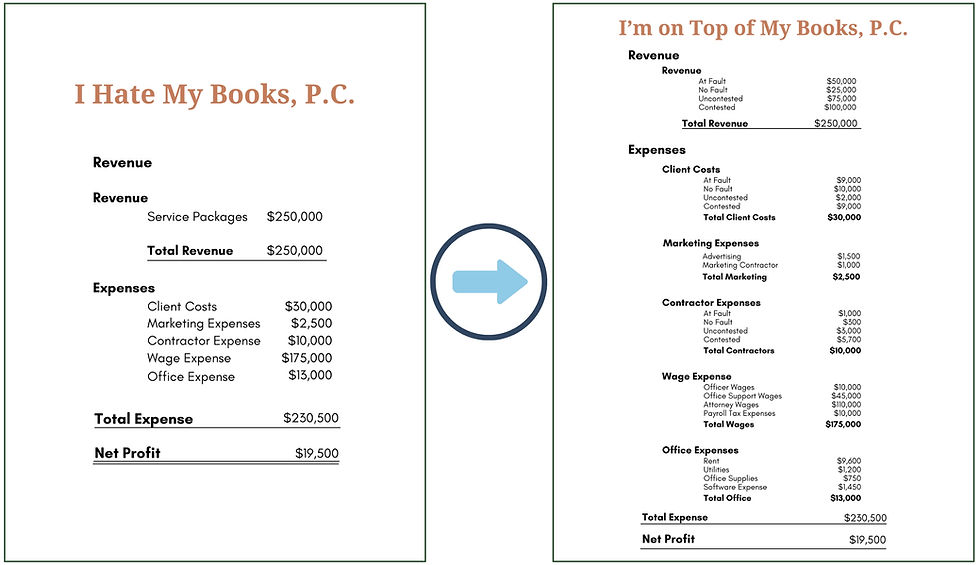
Now every dollar has a job.
Once spending is bucketed, it becomes easier to measure, manage, and adjust. You can see whether payroll is too heavy, whether marketing is producing a return, and whether operations are expanding faster than they should.
Without that structure, the numbers stay noisy. With it, the firm gets a much clearer picture of what is helping profitability and what is quietly eroding it.
Step 3: Protect Profit and Reallocate on Purpose
This is the part many firms miss.
Once better boundaries create extra room, that money should not just sit there without a plan. It should be reviewed strategically. This is where law firm forecasting and budgeting becomes a real operating tool - not just an annual exercise.
That means asking questions like:
Which marketing channels are actually performing?
Are we overfunding low-return spending?
Are there hires producing strong return?
Are there subscriptions, vendors, or systems that are not pulling their weight?
Should this money stay protected as profit or be redirected into a stronger investment?
This is how profit becomes managed instead of accidental. The goal is not just to save money. The goal is to direct money intentionally so the firm gets stronger while still protecting what it earns.
Ready to put a real allocation system in place? Download the free CFO Checklists.
Why Expense Creep Quietly Kills Law Firm Profit Margins
Expense creep is one of the biggest threats to law firm profit margins because it rarely feels dramatic in the moment.
It happens in small ways. A little more payroll. Another tool. A bigger software stack. More miscellaneous operating costs. Extra spending justified by growth, but not always backed by clear return.
Over time, those small decisions become the reason the firm stays busier without feeling more profitable.
That is why profit targets matter so much. They force the business to respect limits instead of expanding automatically.
Real talk: |
If the spending system is broken, extra revenue often just gives the broken system more room to consume. More money does not fix this. Better structure does. |
How to Improve Law Firm Profitability Without More Revenue
This is where the good news is.
Many firms can improve profitability before they ever add more revenue by doing things like:
Setting a target profit percentage. Not what is left over - what the firm intends to keep.
Creating clear allocation buckets. So every category has structure and visibility.
Reviewing underperforming spending. Not all expenses deserve to stay.
Separating growth spending from drift. Money invested on purpose is different from money that just leaks out.
Measuring return more closely. Especially on payroll, marketing, and operational tools.
Making profit part of the operating system. Not just an outcome you check at the end.
These changes can create faster wins than chasing more top-line revenue, because they improve what the firm keeps from what it already earns.

When a Law Firm Fractional CFO Makes Sense
Some firms reach a point where managing profitability, forecasting, and financial structure is too complex to handle without dedicated support - but not complex enough to justify a full-time hire.
That is where a CFO for law firms becomes one of the highest-leverage decisions a firm owner can make.
A law firm fractional CFO brings the strategic financial oversight of a full CFO without the full-time cost. That typically includes:
Building and maintaining a real law firm forecasting and budgeting process
Tracking law firm profit margins over time and identifying erosion before it compounds
Helping owners understand their numbers at a level that actually supports decision-making
Structuring owner compensation so it does not quietly cannibalize firm health
Holding the financial strategy accountable month to month
If you are scaling past $1M in revenue, making hiring decisions that carry real risk, or simply tired of not knowing what your firm is actually keeping - working with a CFO for your law firm is worth a serious look.
What Predictable Profit Actually Looks Like
Predictable profit does not mean every month looks identical. It means the firm is no longer guessing.
It means:
There is a target
There are spending boundaries
Money is allocated intentionally
Adjustments happen based on performance
Profit is protected instead of hoped for
That kind of system changes the way a firm experiences growth. Instead of money disappearing, it gets tracked. Instead of profit feeling random, it becomes visible. Instead of the business eating whatever comes in, the business is forced to operate inside a more disciplined structure.
That is a very different way to run a law firm - and it is exactly what a sound law firm financial strategy makes possible.
Why This Matters for Growth
A lot of owners think profitability is just about taking more home. It is bigger than that.
When profit is clearer and more predictable, the firm makes better decisions about:
Hiring
Marketing
Owner compensation
Reinvestment
Operational efficiency
Long-term stability
That is because profit is not just a reward. It is feedback.
It tells you whether the business model is working, whether spending is aligned, and whether growth is actually healthy.
If profitability stays murky, decision-making stays murky too.

Final Thoughts
If your law firm has had months where the revenue looked good but the bottom line still felt disappointing, you are probably not looking at a simple sales problem.
You may be looking at a broken profit equation.
That is actually good news - because broken systems can be fixed.
Law firm profitability gets stronger when profit is set before spending, expenses are broken into real categories, and money is reallocated intentionally instead of disappearing by default.
The goal is not to hope there is profit left. |
The goal is to build a system that makes keeping profit far more likely. |
Ready to build a profit system that actually works for your firm? Let's talk.
Law Firm Profitability: FAQs (Frequently Asked Questions)
Why is my law firm not profitable / Why is my law firm not making money?
The most common reason is not a lack of revenue - it is a lack of structure around what happens to that revenue after it comes in.
Most firms operate reactively: money comes in, expenses go out, and whatever is left gets called profit. That is not a system. That is a pattern. And without a system, expenses naturally expand to absorb whatever is available. Payroll creeps up. Subscriptions pile on. Operating costs drift. The business stays busy but profit stays thin.
The fix is not always more revenue. It is building a profit structure - one where a target profit percentage is decided before money gets spent, not after.
Related: If your firm has been growing but profit has not kept pace, that is a textbook sign of Parkinson's Law at work - expenses rising to meet or exceed every revenue increase unless a specific force is put against them.
How do I calculate law firm profitability / How do I know if my firm is actually profitable?
There are two numbers worth knowing:
Law firm gross profit: Revenue minus direct costs - such as client-advanced costs and case-related expenses. This tells you what the firm is earning before overhead takes its share.
Law firm net profit: Revenue minus all expenses, including payroll, marketing, operations, and owner draws. This is the real bottom line.
To find your profit margin, divide net profit by total revenue and multiply by 100. A healthy range for most well-run law firms falls between 20 and 40 percent.
If you do not know either of those numbers off the top of your head, that is the first thing to fix - because you cannot manage what you cannot measure.
How do I fix a law firm's profit problem / How do I make my law firm more profitable?
Start before you spend. That is the core shift.
Most firms try to see what is left after expenses. A stronger approach decides what profit should be first - then builds spending boundaries around that target. Here is the three-step framework:
Set a profit target. Decide what percentage of revenue the firm intends to keep before any spending decisions are made.
Break expenses into buckets. Separate payroll, marketing, operations, taxes, owner compensation, and profit so every dollar has a category and a purpose.
Reallocate on purpose. Review spending against return. Ask which channels, hires, and tools are actually performing - and cut or redirect what is not.
Many firms improve profitability before they ever add a new client, simply by tightening the structure around what they already earn.
How do law firms increase profit / How do I improve law firm profitability without more revenue?
More revenue is not always the first answer - and chasing it before fixing the underlying structure can actually make things worse. More money flowing into a broken system just gives the system more room to consume.
Here is what actually moves the needle before adding revenue:
Set a specific profit percentage target and honor it as a non-negotiable line item
Track billable hours more tightly - at a 60% utilization rate instead of 80%, a firm can be leaving over $145,000 in annual revenue uncaptured, and that is before spending a dollar on marketing
Review accounts receivable - money that has been billed but not collected is profit sitting on the table
Audit overhead for drift - subscriptions, tools, and service contracts that no longer earn their keep
Separate overhead from investments - not every expense deserves the same category; some should be measured for return and some should be cut
Profit is not just a byproduct of revenue. It is a discipline.
What is the biggest expense in a law firm?
For firms with employees, payroll is consistently the largest expense category - and the one most likely to grow unchecked as revenue increases.
Inefficient staffing models are one of the most common profit leaks Chelsea sees across law firms. This shows up as:
Overstaffing, or employing full-time staff for tasks that could be outsourced or automated
Employing high-salary team members for work that technology could handle
Not tracking whether billable staff members are hitting healthy utilization rates (the industry benchmark is 80%)
Office space is also a significant overhead line for firms that have not moved to remote or hybrid models. After COVID proved that a large physical footprint is not required to run a successful firm, firms still carrying heavy lease costs are absorbing an unnecessary expense.
The key is not to cut blindly - it is to separate overhead from investment. Payroll can be an investment or a liability depending on whether it is being managed and measured.
How do I know if a practice area is profitable / How do I measure profitability by matter?
This is one of the most underused financial tools in a law firm - and one of the highest-leverage ones.
The highest-revenue practice area is not always the most profitable one. When you look at the actual cost to deliver work in each area - staff time, case-related expenses, overhead allocation - the margin picture can look very different from the billing picture.
To measure profitability by matter or practice area:
Set up your chart of accounts with revenue broken out by practice area and matter type - this gives you a clear view of what each service line is actually generating
Track direct costs (client-advanced costs, billable staff time, case expenses) per matter to calculate gross profit at the matter level
Look at your income statement with both revenue and cost of sales visible so gross profit per practice area is easy to read
Compare revenue contribution versus profit contribution - if one practice area brings in 40% of revenue but only 15% of profit, that gap deserves attention
This level of visibility is exactly what law firm forecasting and budgeting tools and a sound chart of accounts setup should give you. If your current bookkeeping does not allow you to answer these questions, the structure needs to be rebuilt.
What is a healthy profit margin for a law firm?
Most well-run law firms target a net profit margin somewhere between 20 and 40 percent. Where a firm falls within that range depends on size, practice area, staffing model, and overhead structure.
What is more important than hitting a specific benchmark, though, is knowing your number and understanding what is driving it - or eroding it.
A firm generating $800,000 in revenue with a 15% net margin is keeping $120,000. The same firm with a 30% margin is keeping $240,000 - with identical top-line revenue. That difference is entirely a structural one.
If you do not know your current profit margin, or if it has been shrinking while revenue has grown, that is the signal to look at the system, not just the sales.
When does a law firm need a fractional CFO?
A law firm fractional CFO becomes a high-value investment when the financial complexity of the firm has outgrown what a bookkeeper or tax preparer can handle - but a full-time CFO is not yet warranted.
Signs it may be time:
Revenue is at or above $1M and financial decisions are being made from head math or gut feel
Hiring decisions carry real financial risk but there is no forecasting system to stress-test them
Profit margins are unclear, inconsistent, or shrinking despite revenue growth
Owner compensation feels arbitrary or is quietly underfunding firm reserves
There is no active law firm forecasting and budgeting process in place
The firm is scaling and strategic financial planning is not keeping pace
A CFO for a law firm is not just an accountant with a bigger title. It is a strategic partner who holds the financial system accountable month to month, builds forecasts that support decisions, and helps the firm protect what it earns as it grows.
The distinction matters: your bookkeeper keeps your records accurate. Your tax preparer keeps you compliant. A fractional CFO keeps you strategically on track. You need all three - but they are not interchangeable.
What is the difference between law firm gross profit and net profit?
Both numbers live on your income statement and both tell you something important - but they tell you different things.
Gross profit is revenue minus direct costs - the expenses directly tied to delivering your services, such as client-advanced costs and case-related fees. It shows you how efficiently the firm generates revenue before overhead enters the picture.
Net profit is revenue minus all expenses, including overhead, payroll, marketing, taxes, and owner compensation. This is the true bottom line - what the firm actually keeps.
A firm can have strong gross profit and weak net profit if overhead is not controlled. That gap - between what the firm earns on its work and what it actually keeps after all expenses - is exactly where most law firm profitability problems are hiding.
Why does profit feel unpredictable even when revenue is consistent?
Because without a system protecting it, profit is always at the mercy of whatever gets spent first.
This is Parkinson's Law in action: for every increase in revenue, expenses will meet or exceed that increase unless a specific force is working against it. The business will absorb what is available. Payroll expands. Subscriptions accumulate. Spending adjusts up to match whatever feels like growth.
Predictable profit requires active decisions, not passive hope. That means:
A defined profit target set before expenses are allocated
Spending categories with clear limits
Regular financial reviews - monthly, not annually
A cash management system that separates profit from operating funds
The firms that feel financially steady are not the ones making the most money. They are the ones running the tightest system around what they make.
